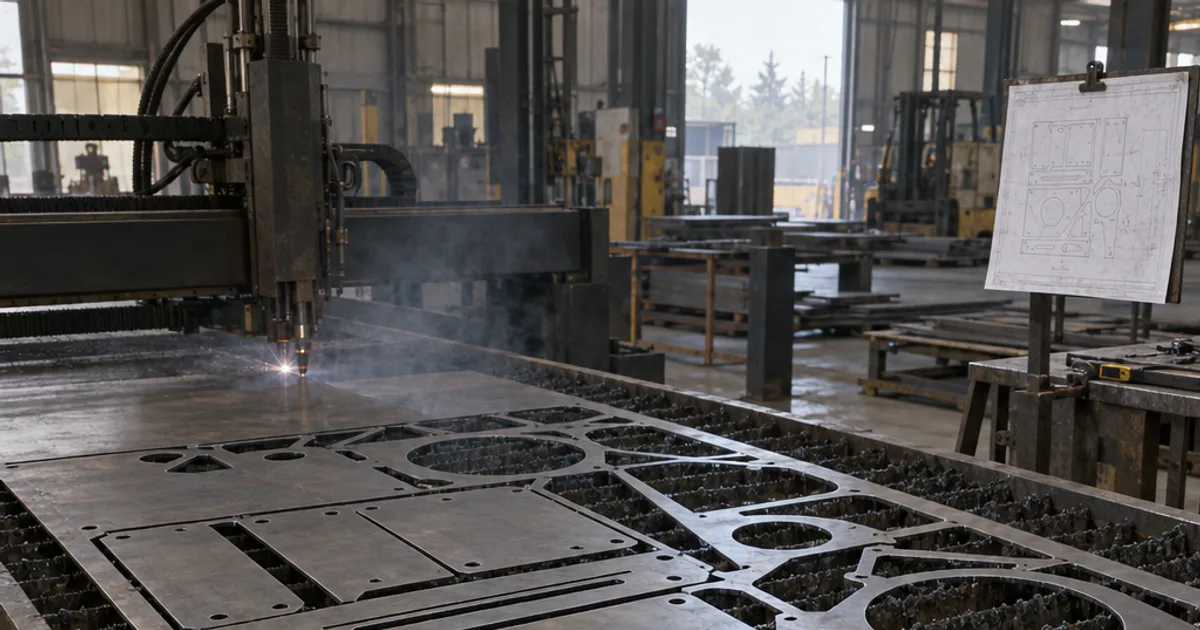
A team I'm working with in the metals business quotes cut steel parts for manufacturers. A single quote can take one of their estimators up to a full day. Before I got involved, someone there had already tried the obvious shortcut: paste a drawing into an AI chatbot and ask for a price. It guessed at the scrap and miscounted the parts.
The easy conclusion is that AI isn't ready for real work. That's the wrong lesson. The chatbot didn't fail because it was dumb. It failed because nobody had ever shown it how that shop works. It was asked to do an estimator's job with none of an estimator's knowledge, and I see that same mistake in almost every business that tries AI and walks away disappointed.
What the chatbot didn't know
Think about what an estimator actually does with a drawing. They know how requests arrive and what usually needs cleaning up before anything can be priced. They know how their shop lays parts out on a sheet of plate, and that layout decides how much steel gets used and how much ends up as scrap. They know the order they work through a price and where their own judgment comes in.
A general chatbot knows none of that. It knows what steel is. It has read plenty about fabrication. But it has never stood in that shop, and it doesn't know the rules that turn a drawing into a number the shop will stand behind. So it did what these tools do when information is missing: it filled the gap with a confident guess.
Scrap is exactly the kind of thing that gets guessed, because it depends on how parts are nested on the plate, and nesting depends on how that shop does it. Counting parts sounds simple until you remember that drawings carry quantities in tables, notes and revisions that someone who reads them every day knows how to catch. The tool didn't, and nobody had told it.
Start with the process, not the tool
So we didn't start by picking an AI model. We started by sitting with the estimators and mapping how a quote really gets built:
- How the work comes in. What a request looks like when it lands, what format the drawings are in, and what has to happen before anyone can price them.
- How parts go on plate. How the shop lays parts out, because that layout drives material and scrap.
- How a price gets built. The steps an estimator works through, in the order they actually do them.
- Where a person has to decide. The points where experience matters and a fixed rule isn't enough.
Once that's written down, the software has something real to follow. What we're building reads the drawings, lays the parts out the way that shop does, and prices the job the way an estimator thinks it through. Their way, not a generic way.
Keep the person who knows at the end
An estimator still checks every quote and signs off. That part isn't up for debate.
A quote is a promise. Price it too low and the shop eats the difference. Price it too high and the job goes somewhere else. Software can take on the reading, counting and arithmetic that eat most of the day. The estimator's job shifts from building every quote from scratch to reviewing one that's already built and catching what looks off. That's a better use of the most experienced person in the room, which is the point I made in AI Won't Fire Your Team. It Changes the Job.
It's early. The goal is a full day of quoting down to minutes, and I'm not going to claim more than that until it's proven in their shop, on their jobs.
This isn't a steel problem
Swap out the industry and the pattern holds.
A contractor asks a chatbot to estimate a remodel and gets a number that ignores how they price labor and what their suppliers charge. A distributor lets an AI tool answer stock questions without connecting it to how inventory is actually allocated. A salon lets software book appointments without knowing which services need a consultation first. A front office has AI draft customer replies that read well and promise things the business doesn't do.
In every case the tool is capable. It just hasn't been taught. The fix is the same one I described in People, process, product: find where the work really happens, then build the tool to follow it.
Before you buy an AI tool, write down how the work gets done
This is the step most businesses skip, and it's the one that decides whether AI helps or guesses.
- Pick one job that eats time. Quoting, order entry, scheduling, month-end billing. One job, not the whole business.
- Watch the person who does it best. Don't ask them to describe it from memory. Sit with them while they do it, start to finish.
- Write down every input. Where the information comes from, what shape it arrives in, and what gets fixed before it can be used.
- Write down the rules nobody has written down. "We always round this up." "This customer gets the old price." "We never quote that without a site visit." Those unwritten rules are what a tool will guess at if you don't hand them over.
- Mark where a person decides. Those stay with a person.
- Then look at tools. Now you can tell whether a tool will follow your process or make one up.
That page of notes is worth more than any demo. It's also how every custom build we take on starts.
If you've tried an AI tool that guessed when it should have helped, I'd like to hear about it. Book a Discovery Call and we'll look at how the work really gets done in your business, and whether software can do it your way.